
This opinion piece first appeared in the Des Moines Register January 26, 2026.
Click here to read the Article on the Register website.
I said I’m a Democrat. She snapped my campaign flyer back to me. “You’re going to reject me just because of that?” I asked. “Yes,” she said.
You learn a lot by running for the legislature in rural southeast Iowa — especially if you’re a Democrat.
My first hard lesson came while canvassing in a Van Buren County town (it would be redundant to say it was a small Van Buren County town) on a hot September Sunday.
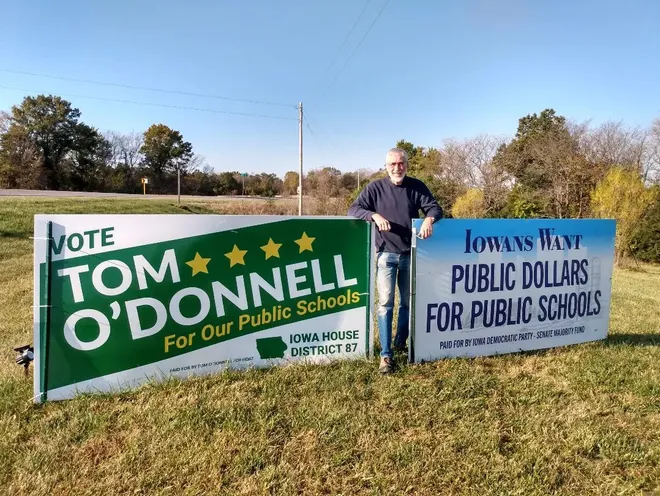
A stern middle-aged woman answered my knock. She frowned, her brow wrinkled, as I introduced myself. Although she home-schooled her children, she listened as I talked about education in rural Iowa, the issue I focused on in my campaign for House District 87: how Republican politicians chronically underfund public schools, about the private school tuition voucher plan they passed, and about the limits they placed on Area Education Agencies, which provide special education, literacy consulting, staff training and other services rural schools depend on.
I could see her face change and her skepticism fade. Then I said I’m a Democrat. She snapped my campaign flyer back to me.
“You’re going to reject me just because of that?” I asked.
“Yes,” she said. There was no point in arguing. After that, I rarely mentioned my party unless a voter asked.
I got a similar reception from other Republicans. Many agreed with my positions. A few said they’d vote for me. But most said something like, “I need to do more research.”
I’m not the brightest guy. It took me a while to realize “more research” meant checking my party affiliation. Acquaintances told me they know people who would’ve voted for me if I was a Republican. Other Democratic candidates said they had similar experiences.
I got on the ballot in late August, just beating a state deadline. I didn’t want to run, but no candidate with support from the district’s three county Democratic parties stepped up to take on the incumbent, Jeff Shipley. House 87 encompasses Van Buren County, where I live, and parts of Jefferson and Henry counties, including the small cities of Fairfield and Mount Pleasant.
Democrats are reluctant because Republicans have a significant registration advantage in the district, and no party voters probably lean toward the GOP. Shipley was finishing his third term and easily won in 2022. With those factors, the Iowa Democratic Party wouldn’t help fund a 2024 candidate.
On the other hand, winning would remove a divisive and controversial incumbent. Shipley is known for questioning vaccinations, especially for COVID-19, and once said the coronavirus wasn’t killing anyone. He’s made many other reckless and strange quips. Worst of all, Shipley attacks transgender people and has made revoking their civil rights his signature issue.
The 11-week campaign was the most intense time of my life. We staged a solid effort, thanks to dedicated volunteers and generous donors. The state party, through the arm designated to assist House candidates, helped — although I sometimes had to fight for assistance — but, as expected, sent no money.
I’ll spare you the suspense: I — and virtually every other rural Iowa Democrat — lost. Shipley ended with 57.5%, I had 39.5% and Curtis Oliver, an independent who graciously endorsed me when he learned I was running, received 2.7%.
Democrats have won before in Van Buren County and the area. Former county recorder Twyla Peacock and John Whitaker, a former county supervisor and state representative, told me they spent months knocking on every door.
That was more than 20 years ago. Today, the highest-ranking Democrat in Van Buren County is the beloved treasurer, Linda Whitten. Few other Democrats could win, even if they visited every home. Republican voters often acknowledge their party’s policies harm them and their communities but are still reluctant to choose Democrats. The R after the name matters more.
My party can be just as tribal, but polling finds voters generally like our policies, which evidence often shows would improve their lives.
Our campaign may have been hopeless, but the experience changed me. Canvassing introduced me to people doing their best under difficult conditions, such as substandard, worn housing and subsistence incomes. I also saw magnificent parts of Van Buren County, where rolling, wooded hills and valleys glowed in the autumn twilight.
Perhaps the most amazing things I learned, however, were about myself.
I’m not naturally sociable, but as a candidate, I was astounded at how easily I could talk with voters, even skeptical ones.
Similarly, I’m a decent public speaker, but I was surprised I could address gatherings without notes or pacing nervously. I found my voice rising in anger at Republicans’ damaging policies. Discussing things I believe in gave me confidence.
Supporters want me to try again. I’m undecided, but the thought of campaigning with more time to meet voters is intriguing.
Regardless, I’ll always be grateful for what voters gave me — even in losing.
Thomas R. O’Donnell
Thomas R. O’Donnell is a retired science writer and former newspaper reporter and editor. He lives near Keosauqua, Iowa.